Amy Sauly: Elegant Handwritten Font for Crafters & Sellers
If you’ve ever spent hours searching for a script font that feels personal but polished—something that whispers “handmade with care” without sacrificing clarity or commercial versatility—you’ll understand why Amy Sauly has become my go-to for physical and digital product design. As a small shop owner who creates printable planners, wedding stationery, candle labels, and boutique tags, I need fonts that look beautiful *and* hold up in real-world production—and Amy Sauly delivers exactly that.
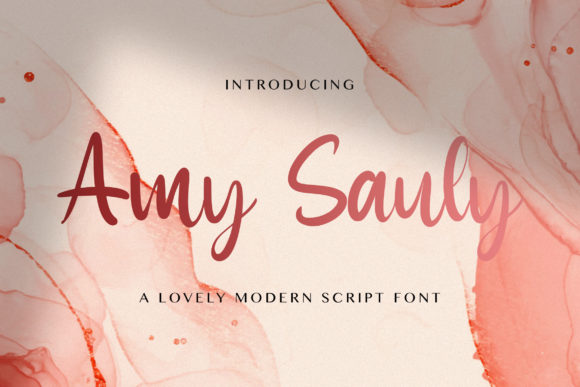
Amy Sauly is a delicate, elegant, and flowing handwritten font—but it’s not overly ornate or fragile. Its characters are beautifully balanced, with gentle curves, consistent spacing, and subtle contrast between thick and thin strokes. That balance is what makes it so versatile: it reads clearly at 12pt on a tiny sticker tag, yet commands attention at 120pt on a farmhouse-style wall sign. It’s the kind of script font that feels intentional—not like a rushed signature, but like something carefully composed for your brand.
I use Amy Sauly across nearly every category I design for: greeting cards (especially birthday and thank-you notes), wedding welcome boards, baby shower invitations, seasonal product packaging (think lavender soap boxes or holiday cookie tins), and even heat-transfer designs for mugs and tote bags. Its elegance lifts simple layouts instantly—pairing it with a clean sans serif like Montserrat or Poppins gives me instant brand cohesion, whether I’m designing a digital download or a physical label. For SVG files used in Cricut or Silhouette projects, Amy Sauly cuts cleanly thanks to its open counters and well-defined terminals—no sticky joins or unintended overlaps, even at smaller sizes.
Readability matters—especially when your font appears on a 1-inch product tag or a printed planner page. Amy Sauly shines here because it avoids excessive flourishes. There are no distracting swashes on default characters (though many versions include optional alternates and ligatures if you want to add a touch of extra charm to headlines or logos). I keep the standard character set for body text—like “Hand-poured Soy Wax” on candle jars—and save the stylistic alternates for titles, monograms, or social media graphics where I want a little more personality.
One of the quiet strengths of Amy Sauly is its PUA encoding. That means all special characters, ligatures, and alternates show up reliably in design software—no hunting through glyph panels or guessing which key combo triggers the swash ‘y’. For sellers building Canva templates or layered PSD files for digital downloads, this saves real time and prevents customer confusion. It also means multilingual support is straightforward if your shop serves customers beyond English-speaking markets (check your specific license for language coverage).
When pairing Amy Sauly, I almost always reach for a neutral sans serif as a foundation. Think crisp headings in Amy Sauly over soft, readable body text in Open Sans or Lato. For vintage-inspired packaging or apothecary labels, I sometimes layer it with a refined serif like Playfair Display—but only for contrast, never competition. The goal is harmony: let Amy Sauly carry the emotional weight while the supporting font handles clarity and structure.
Practically speaking, Amy Sauly works best for short-to-medium phrases: names, titles, quotes, product descriptors (“Small Batch • Locally Made”), and decorative accents. It’s not meant for long paragraphs—but then again, neither are most script fonts. That’s fine. In craft-based selling, we’re rarely typesetting novels—we’re crafting moments: a first impression on a gift tag, a warm welcome on a wedding chalkboard, a sense of luxury on a boutique soap label. Amy Sauly helps those moments feel cohesive, considered, and quietly confident.
I’ve tested it across multiple outputs: printed on kraft paper tags (it holds richness without bleeding), cut from vinyl for stickers (clean edges, no fraying), rendered in mockups for Etsy listings (it looks premium even in thumbnails), and embedded in PDF printables (no font substitution surprises). And because it’s part of the Script Amp collection, I know it’s been optimized for both aesthetic appeal and technical reliability—something that matters when your livelihood depends on consistent, professional results.
Licensing is worth mentioning plainly: Amy Sauly is a commercial font, and its license covers physical product creation (stickers, apparel, mugs), digital downloads (planners, invitations, SVG bundles), client work, and template sales—as long as you’re using it as a design element, not redistributing the font file itself. Always double-check your license terms before bundling it into editable Canva templates or reselling font files—but for makers who design *with* fonts rather than *as* fonts, Amy Sauly fits seamlessly into your workflow and your shop’s legal framework.
Whether you're hand-lettering a wedding welcome board or batch-printing 500 tea box labels, Amy Sauly adds a layer of thoughtful craftsmanship that customers notice—even if they can’t name why. It doesn’t shout. It invites. It elevates. And in a crowded handmade market, that quiet distinction is everything.
- Candle & soap makers: Use Amy Sauly for ingredient lists, scent names (“Vanilla + Cedar”), and “hand-poured” callouts on front labels
- Wedding stationers: Apply it to ceremony programs, place cards, and acrylic welcome signs—its flow mimics real penmanship without looking generic
- Printable creators: Layer it over minimalist planner pages or habit trackers for a soft, approachable tone
- SVG designers: Pair it with bold geometric shapes for modern farmhouse wall art or quote-based digital cut files
- Boutique owners: Stamp or foil-deboss Amy Sauly onto cotton tags—it translates beautifully to tactile finishes
At its core, Amy Sauly isn’t just another pretty script font. It’s a practical tool—one that supports your voice, strengthens your brand identity, and helps your handmade products land with warmth, authenticity, and polish. When your typography feels like an extension of your craft, your customers feel it too.